
How Many Trades Should You Backtest?

Sofia IvanovaHead of Customer Success
Key takeaways
- Backtest at least 100 trades per setup to see promise, 300+ before trusting it, and around 1,000 for real confidence.
- Small samples lie: a 55% win-rate strategy can easily show 40% or 70% over 20 trades.
- Count samples per strategy, not per account — five setups tested 60 times each is five samples of 60, not one of 300.
- With bar replay, 300 trades takes a weekend to a couple of weeks, not months.
- If a strategy is clearly negative after 100+ honest trades, kill it or redesign it — don't nurse it.
You should backtest at least 100 trades per setup to see if it has promise, 300+ trades before you start trusting it, and around 1,000 trades if you want real confidence. Small samples let luck disguise the truth.
Twenty good trades can make a bad strategy look brilliant. Twenty bad ones can make a perfectly workable strategy look broken.
The job of backtesting is to find out which one you're actually dealing with.
The short answer
For most retail trading strategies, use these numbers:
- 100 trades: Minimum useful sample. Enough to decide whether the setup deserves more testing.
- 300+ trades: A much stronger sample. This is where you can start trusting the broad characteristics of the strategy.
- Around 1,000 trades: Strong confidence. You have seen enough trades for random streaks to matter much less.
These aren't magic thresholds. Trade 301 doesn't suddenly turn your backtest into scientific fact.
The point is simple: more trades give luck fewer places to hide.
If you've tested a strategy 17 times and won 13 of them, you haven't found the Holy Grail. You've found 17 trades. Keep going.
Why small samples lie
Imagine flipping a fair coin 20 times. You know the true probability of heads is 50%. But you shouldn't expect exactly 10 heads every time you run a set of 20 flips.
You might get 13 heads. You might get seven. Nothing about the coin changed.
That's variance.
Trading has the same problem, except it's messier. Your trades aren't literal coin flips, and outcomes depend on the rules you're testing, market conditions, exits, risk management and plenty else.
A small sample can therefore produce a very convincing illusion.
You backtest 20 trades. Sixteen win. The equity curve looks beautiful. Your confidence shoots through the roof and you're already mentally pricing the yacht.
Then you test another 100. Things look rather different.
That first batch may simply have landed during favourable market conditions. Or you happened to catch a winning streak early.
The opposite happens too. A potentially useful strategy can lose several trades in a row near the beginning of a test. If you stop after 15 or 20 trades, you might bin it before its longer-term behaviour has had any chance to appear.
That's why how many trades to backtest matters as much as how carefully you backtest them.
You're not looking for a pretty run of winners. You're looking for behaviour that survives repetition.
Win rate confidence without the maths degree
Suppose a strategy's true long-run win rate is roughly 55%.
Test it over just 20 trades and the result can bounce around dramatically. You could easily see something closer to 40% in one small sample and 70% in another.
That doesn't necessarily mean the strategy stopped working between tests. It means 20 trades are noisy.
Now run hundreds of trades. As your sample grows, extreme results become harder to sustain. Your observed win rate tends to settle closer to the strategy's underlying behaviour.
At 500 trades, a strategy with a genuine 55% win rate is far less likely to masquerade as a 40% or 70% strategy than it was after 20.
That's the practical point. You don't need a statistics degree to use it.
Small sample = wide range of plausible outcomes. Large sample = much harder for luck to dominate the result.
And don't obsess over win rate alone. A 40% win-rate strategy can be profitable if its winners are sufficiently larger than its losers. A 70% strategy can still lose money if the occasional loss wipes out a pile of small wins.
Your backtest should tell you how the complete setup behaves, not just how often the little green box appears.
One number per strategy, not per account
Here's an easy mistake. You backtest:
- 60 EUR/USD London breakout trades
- 60 GBP/USD trend trades
- 60 New York reversals
- 60 gold momentum trades
- 60 EUR/USD mean-reversion trades
That's 300 trades. But you do not have a 300-trade sample for a strategy. You have five 60-trade samples.
Different setups can have completely different win rates, payoff profiles, losing streaks and sensitivities to market conditions. Mixing them together hides that information.
The same applies when you change important variables within one strategy. If your London-session setup behaves differently from your New York-session version, combining them can make the aggregate numbers look sensible while neither version actually performs that way on its own.
Treat each meaningful setup + market + session combination as its own sample where those variables change the strategy materially.
You want to be able to say: "I tested this exact setup 300 times." Not: "I've taken 300 vaguely related trades and the spreadsheet looks encouraging."
Those are very different claims.
How long does 300 trades take?
Manually waiting for 300 trades to appear in real time can take months. That's exactly why bar replay exists.
With replay backtesting, you move through historical charts and execute the setup as though the market were unfolding live. You can collect a meaningful sample without waiting for the calendar to cooperate.
Depending on how frequently your setup appears, 300 trades can take anywhere from a concentrated weekend to a couple of weeks of testing. A setup appearing several times per session is obviously quicker to test than one appearing twice a month.
The important part is not to rush the individual decisions. Going faster is useful. Changing the rules halfway through because trade 74 annoyed you isn't.
Traders Casa gives you TradingView-powered charts and bar replay with one-minute data across all plans. The free plan is free forever and includes unlimited backtest sessions, six months of historical data, a P&L graph and consistency tracker, with no card required.
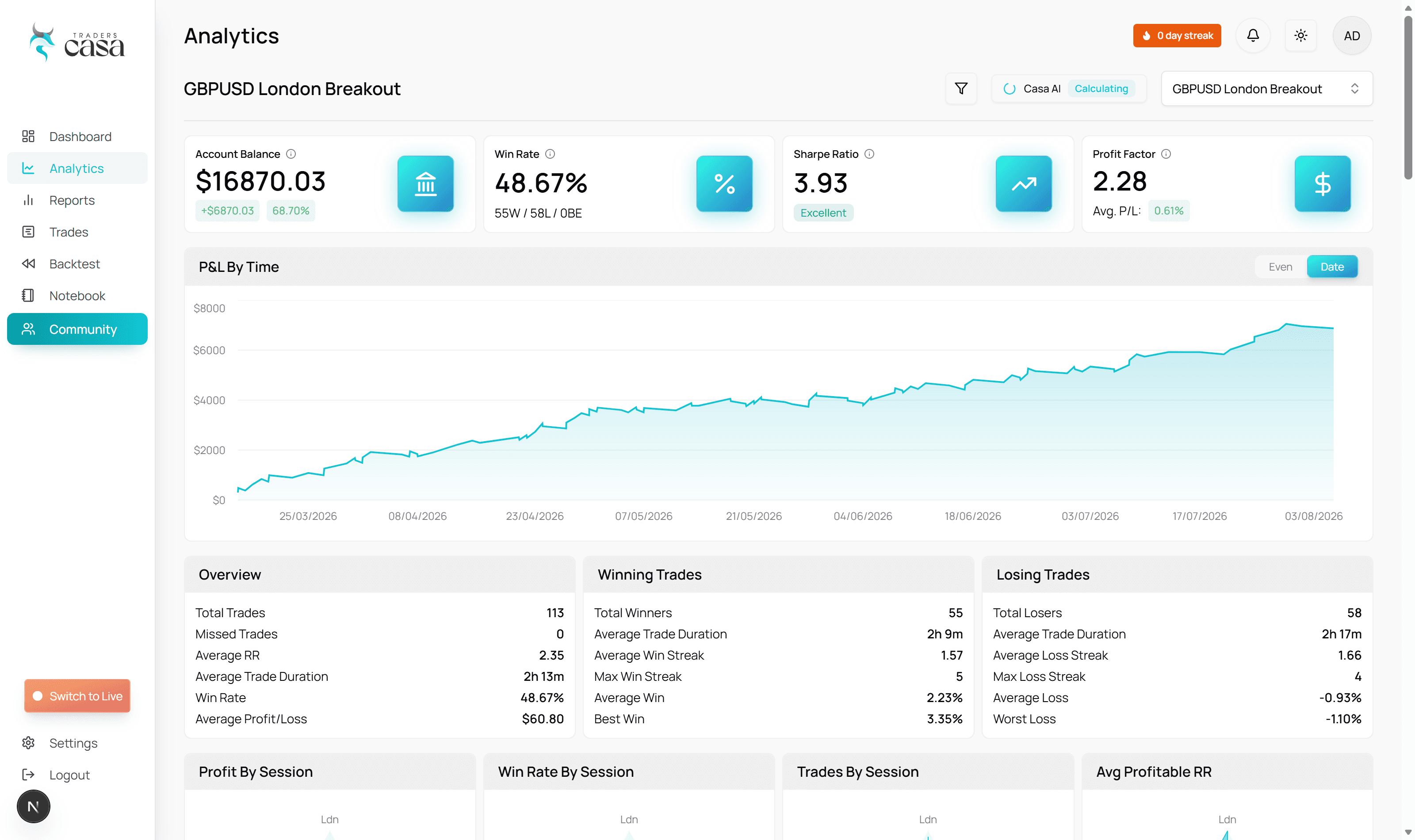
If six months doesn't give your strategy enough occurrences, Basic extends historical data to six years. Pro gives you 20+ years, plus live trade journalling, broker sync and 300+ analytics.
The point of replay isn't to manufacture a great backtest. It's to compress the time required to collect enough honest trades to find out whether the strategy deserves your attention.
When to stop and move on
More data is useful. More data on an obviously broken idea isn't always useful.
If a strategy is clearly negative after 100+ honestly executed trades, don't spend the next six weekends trying to emotionally negotiate it back into profitability. Kill it or redesign it.
"Honestly executed" matters. You can't take every valid signal for 60 trades, skip the ugly-looking ones for the next 25, change the stop halfway through and then call the final result a backtest. You've tested several different strategies without admitting it.
If you change a meaningful rule, treat the revised version as a new test. Start collecting its sample separately.
The first 100 trades are your filter. Does the setup show enough promise to justify another 200? If yes, continue.
At 300+, you can start asking more serious questions about consistency, losing streaks, profitability and whether the results hold across different periods. If it keeps surviving as you move towards 1,000 trades, your confidence has a much stronger foundation.
Not certainty. Trading doesn't offer that. Just considerably better evidence than "it worked 14 times on EUR/USD last Tuesday."
For the full process — rules, data, review, forward testing — see our guide on how to backtest a trading strategy.
FAQ
Is 30 trades enough to backtest?
No. Thirty trades can give you an early impression, but variance can still dominate the result and make a weak strategy look strong — or the reverse. Aim for at least 100 trades before judging whether a setup has promise, then push towards 300+ before placing much trust in the numbers.
How many years of data should I backtest?
Use enough historical data to generate a meaningful number of trades across different periods rather than chasing a fixed number of years. A high-frequency setup might produce hundreds of trades within months, while a low-frequency strategy may need several years to reach the same sample. Traders Casa's free plan includes six months of historical data, Basic includes six years, and Pro includes 20+ years, so the appropriate amount depends mainly on how often your setup occurs.
Quick Recap
- 100 trades per setup is the minimum before deciding whether a strategy shows promise.
- 300+ trades gives you a much stronger basis for trusting its broad behaviour.
- Around 1,000 trades gives you stronger confidence because random streaks have much less influence.
- Twenty or 30 trades can look spectacular purely because of variance.
- Count samples per strategy, not across a pile of unrelated setups.
- Bar replay lets you collect hundreds of historical trades far faster than waiting months in demo.
- If a strategy is clearly negative after 100+ honest trades, kill it or redesign it.
- If you materially change the rules, start a new sample.
The goal isn't to prove your strategy works. It's to give it enough chances to prove you wrong.
If you're logging the sample by hand, our free backtesting spreadsheet works out expectancy, profit factor, consecutive losses and drawdown in R for you. And if the sample exists because a prop firm evaluation is coming, read prop firm backtesting next — sample size matters less than whether the losing sequences would have breached a drawdown rule.
Collect your 300 trades in days, not months: unlimited free backtest sessions with bar replay on TradingView-powered charts and auto-logged results.
Start backtesting free