
Bar Replay: How to Practice Trading on Historical Data

Sofia IvanovaHead of Customer Success
Key takeaways
- Bar replay means replaying historical charts candle by candle without seeing future price action — decisions get made before you know the outcome.
- It beats scrolling back on completed charts because it removes hindsight bias: you can't unsee the future once it's on your screen.
- Test one strategy and one pair at a time, take every valid setup, and log losers with the same care as winners.
- Never rewind. Trading does not have Ctrl+Z, and neither should your backtest.
- Use bar replay first for fast historical testing, then demo trading to validate real-time execution.
Bar replay lets you replay historical charts candle by candle as if the market were live.
Instead of looking at a completed chart and convincing yourself you would have taken the perfect entry, you hide the future and make decisions with only the information that would have been available at the time.
That makes bar replay one of the most useful ways to practise a trading strategy before putting it through demo trading or risking real money.
But there is a catch. Replay is only useful if you treat it like trading. If you rewind every bad entry, skip ugly setups and hunt for perfect weeks, you are not backtesting.
You are editing the past.
What is bar replay?
Bar replay is a backtesting method where you choose a point on a historical chart, hide everything that happened afterwards, then reveal the market one candle at a time.
You analyse each new candle as it appears. When your strategy gives you an entry, you take it. When it does not, you wait.
The important part is that you cannot see what happens next.
Suppose you are testing EUR/USD on the one-minute chart. You start on a historical date, move forwards candle by candle and follow the exact same rules you intend to use when trading. Your process might look like this:
- Check whether market conditions meet your strategy rules.
- Wait for your setup.
- Enter when your trigger appears.
- Place your stop and target according to your rules.
- Continue the replay.
- Record the result.
- Move to the next setup.
That is bar replay trading in its simplest form. You are effectively putting yourself back into a historical market without knowing the ending.
It is not live trading. There is no real money involved, and replay cannot perfectly reproduce every part of executing a live trade.
But for testing whether a set of trading rules actually holds up across historical data, it is considerably more useful than staring at old charts and saying, "Yep, I'd have bought there."
Why bar replay beats scrolling back on charts
Scrolling backwards through a completed chart has one enormous problem: you can see the future. Once you have seen what happens next, you cannot unsee it.
Imagine you scroll back and find a breakout followed by a huge rally. The breakout suddenly looks obvious. The trend looks clean. The entry looks easy. The warning signs look irrelevant.
You might tell yourself you would have entered. Would you? Maybe. But you are making that decision while looking directly at the outcome.
That is hindsight bias.
It becomes even worse when reviewing losing setups. If you can already see price reversing after an entry, suddenly you notice ten reasons you supposedly would have avoided the trade. Convenient.
Bar replay removes that advantage. The candles to the right are hidden, so you have to make a decision before you know whether it wins or loses.
You see the setup as it actually develops: "This meets my rules. Do I take it?" Not: "This trade made 4R. How can I justify taking it?"
That difference matters because a trading strategy needs rules you can execute without knowing what happens next.
Replay also exposes ambiguity. A strategy might sound perfectly clear in your head: "Buy when it looks strong."
That is not a strategy.
After 30 replay trades, you will probably discover that "strong" can mean six different things depending on whether you want the trade to qualify. Good backtesting forces you to define it.
What exactly has to happen before you enter? What invalidates the setup? Where does the stop go? When do you exit? If you cannot answer those questions while the future is hidden, you probably do not have a testable strategy yet.
How to run a bar replay session
Start with one strategy and one pair. Do not test your breakout strategy on EUR/USD, switch to GBP/JPY after three losses, then try a moving-average setup because you are bored.
You want a clean sample. If you change the strategy, instrument and rules constantly, you will have no idea what your results actually represent.
Next, choose your historical starting point. Do not cherry-pick a date because you already know the market trended beautifully afterwards. Choose the period without knowing exactly what comes next. Then hide the future data and begin.
From there, the workflow is straightforward.
Step through the chart bar by bar. You do not need to inspect every candle for five minutes. Move at a sensible pace, but stop whenever new information would require a trading decision.
Take every valid setup. This is where discipline starts to matter. If your written rules say the trade qualifies, log it. Do not skip it because the chart looks messy. Do not suddenly add an extra confirmation because the last two trades lost. Equally, do not loosen your rules because you have gone 40 candles without an entry. Your strategy does not owe you entertainment.
Manage the trade according to the same rules every time. If your rules say the stop stays where it is, leave it there. If you trail after a particular condition, wait for that condition. If your exit is fixed, do not suddenly become a discretionary trade-management genius because you can sense a reversal coming.
Log every trade. At minimum, you need enough information to reconstruct what happened and determine whether you followed the strategy.
The point is not simply to produce a win rate. You want to know whether the rules are repeatable and whether you are actually following them consistently. A backtest with 100 trades and sloppy execution tells you less than you think.
Bar replay vs demo trading
Bar replay and demo trading solve different problems. You should normally use both. Start with bar replay. Then move to demo trading.
The major advantage of replay is speed. In live markets, testing a strategy properly can take months because you have to wait for setups to appear.
With replay, you can move through historical data much faster. You can compress months of market behaviour into a weekend of focused testing rather than waiting months for the calendar to do the work for you.
That makes replay ideal for answering the first question: does this strategy deserve more testing?
Once you have a defined strategy and a meaningful replay sample, demo trading becomes useful for a different reason. Demo forces you to operate at market speed. You cannot skip forwards until something interesting happens. You have to wait.
That helps you test practical execution and your response to boredom, hesitation and uncertainty.
Replay tells you whether your rules appear to work historically. Demo helps you find out whether you can actually execute those rules as the market develops in real time.
Neither guarantees what will happen with real money. But doing them in the right order makes sense. Test the idea quickly with historical replay first. If it survives, validate your execution under forward-moving demo conditions. (We've compared the two approaches in depth: backtesting vs paper trading.)
The rules that keep replay honest
Bar replay becomes useless remarkably quickly if you start bending the rules.
Never rewind. You entered. Price immediately went against you. You realise you "misread" something. Too late. Record it.
Rewinding teaches you that mistakes can be deleted. Trading does not have Ctrl+Z.
Use a written checklist. Your entry should not depend on how persuasive the chart looks in the moment. Write down the conditions that must be present before you take a trade. Then follow them.
If you discover during testing that a rule needs changing, that can be useful information. But do not quietly change the rule halfway through and pretend the whole sample was generated using the same strategy. You have changed the test.
Collect 100+ trades before judging the strategy. Ten trades can feel dramatic. Three losses in a row can make a strategy look broken. Three winners can make you wonder whether you have finally cracked the market. Neither tells you much on its own.
Build a larger sample before drawing conclusions — here's how many trades you actually need. The goal is to see how the same rules behave across different sequences and market conditions.
Log your losers with the same care as your winners. Winning trades are fun to screenshot. Losing trades are usually more educational.
Record whether the losing trade followed your rules. A valid setup that loses is not necessarily a mistake. Likewise, a trade that breaks your rules and happens to win is not suddenly good execution. That distinction matters. You are testing a process, not collecting attractive charts.
Where to use bar replay
There are two obvious ways to start bar replay trading: use the replay tools inside TradingView, or use a dedicated backtesting platform such as Traders Casa.
TradingView's built-in replay
TradingView has built-in chart replay, so it is a familiar place to start if you already use its charts. You can select a historical point and move forwards through the chart rather than seeing all future price action at once. (Full walkthrough: how to backtest on TradingView.)
The downside is that the free tier has limitations, and you do not get a persistent trade journal built around your replay results. That means you may need a separate process for recording and analysing your backtests.
For occasional chart practice, that may be enough. If you want to build a repeatable testing routine, keeping the replay and results together becomes more useful.
Traders Casa
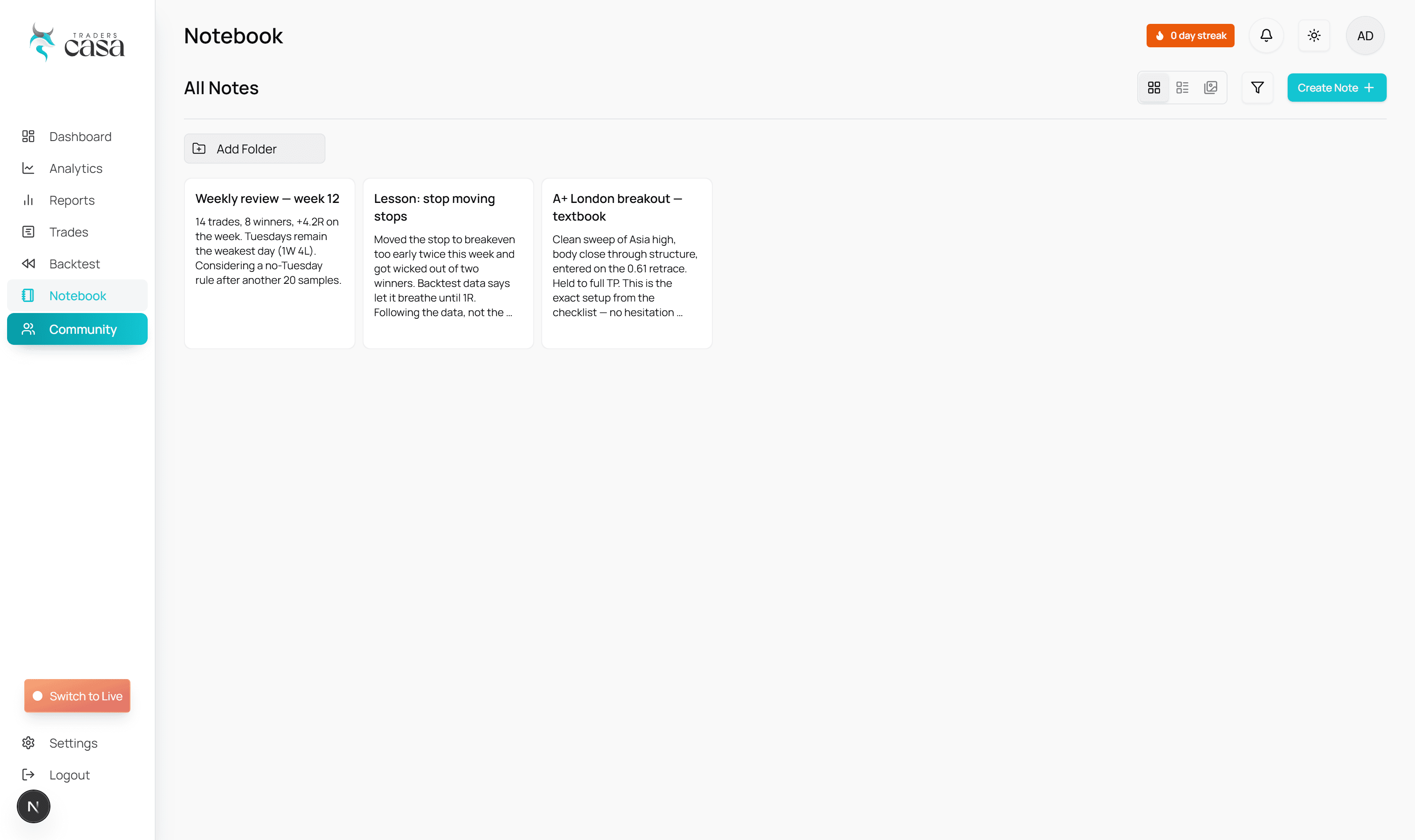
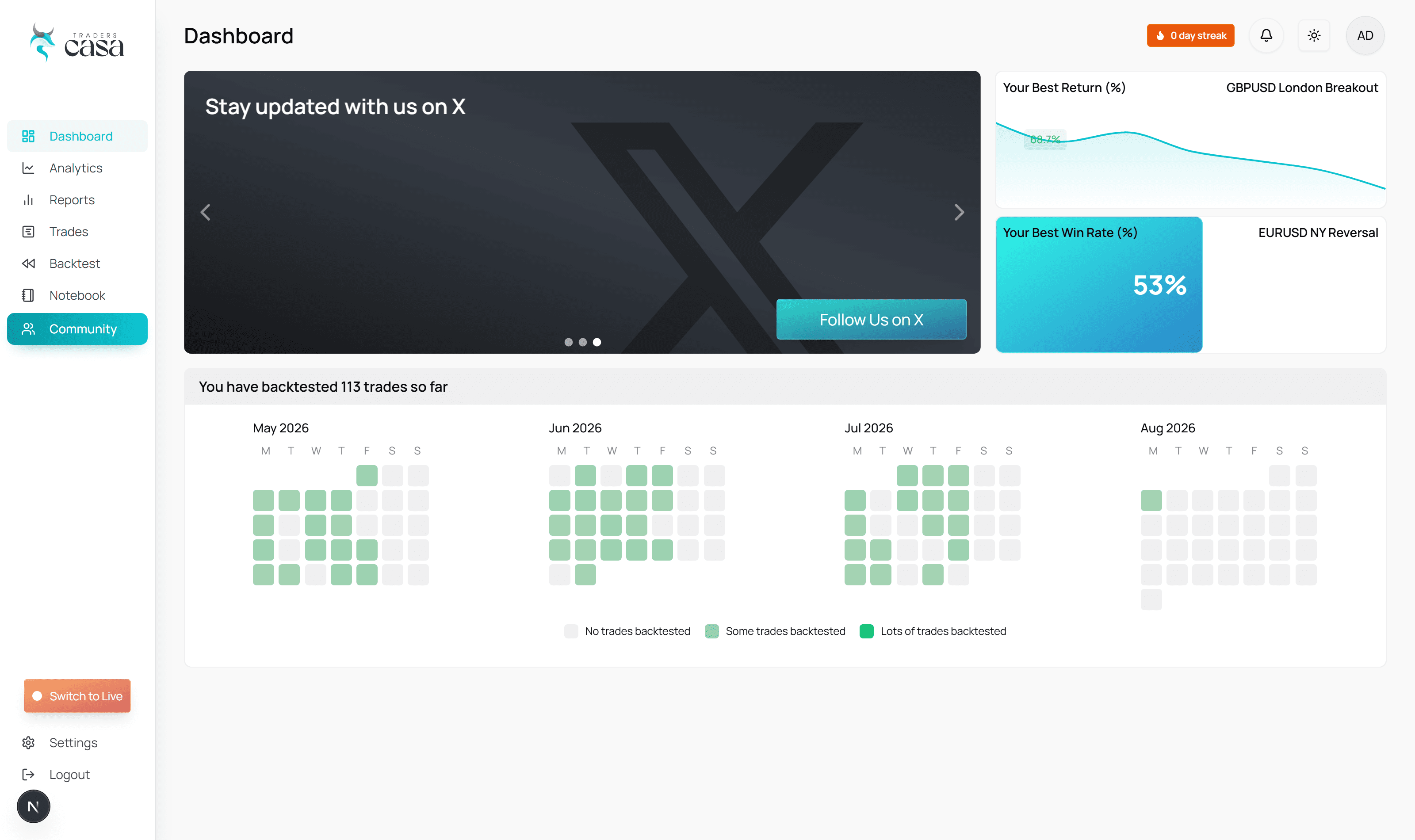
Traders Casa gives you bar replay backtesting on TradingView-powered charts with one-minute data.
The free plan is free forever. You get unlimited backtest sessions, six months of historical data, a P&L graph and a consistency tracker, with no card required.
Your results are auto-logged, so you can test the strategy and review its performance without maintaining a separate spreadsheet every time you run a session.
If you need more history, Basic provides six years of data. Pro provides 20+ years of data, plus live trade journalling, broker sync and 300+ analytics.
Traders Casa is not a broker and does not provide trading signals. The point is to test your strategy.
With 750,000+ users and 15,000,000+ backtested trades, Traders Casa is built around the repetitive part of getting better at trading: test, log, review, repeat.
FAQ
Is bar replay realistic?
Bar replay is realistic in the sense that you make decisions without seeing future candles, which removes a major problem with manual chart review. It still cannot perfectly reproduce live execution, so use replay to test your rules and demo trading afterwards to test how you execute them in real time.
Is bar replay free?
It can be. TradingView offers built-in replay with limitations on its free tier, while Traders Casa offers a free-forever plan with unlimited backtest sessions, six months of historical data, one-minute data, auto-logged results, a P&L graph and a consistency tracker with no card required.
How many replay trades do I need?
Aim for at least 100 trades before making a serious judgement about a strategy. More data can give you a broader picture, but the first priority is making sure every trade in your sample follows the same written rules.
Quick Recap
- Bar replay means replaying historical charts candle by candle without seeing future price action.
- It is more useful than scrolling through completed charts because it reduces hindsight bias.
- Test one strategy and one pair at a time.
- Choose historical periods without cherry-picking favourable conditions.
- Take every setup that meets your written rules.
- Never rewind a losing trade or quietly change the rules halfway through.
- Log winners and losers with the same level of detail.
- Build a sample of at least 100 replay trades before judging a strategy.
- Use bar replay first for fast historical testing, then demo trading to validate real-time execution.
Free-forever bar replay on TradingView-powered charts: unlimited sessions, one-minute data, and results that log themselves.
Start backtesting free