
Forex Backtesting: The Complete Guide

Sofia IvanovaHead of Customer Success
Key takeaways
- Forex backtesting means applying fixed trading rules to historical price data and recording every valid trade — testing the strategy, not proving it.
- Forex suits backtesting because it trades 24/5 across defined sessions, producing large numbers of testable setups.
- Manual bar replay suits discretionary traders; automated backtesting suits strategies that can be expressed as precise coded rules.
- Data quality is the silent killer: intraday strategies need one-minute data, and realistic spreads, sessions and slippage assumptions.
- Judge results on risk-to-reward, expectancy, max drawdown and losing streaks — never win rate alone.
Forex backtesting is how you find out whether a trading strategy has actually worked on historical price data.
Instead of looking at a chart and thinking, "Yeah, I would've taken that trade," you define your rules first, replay the market without seeing the future and record what happens.
Do it properly and you get evidence. Do it badly and you get a very detailed explanation of how profitable you would have been if you'd known what happened next.
This guide covers how to backtest forex, what data and metrics matter, and the mistakes that can make an apparently profitable strategy fall apart.
What is forex backtesting?
Forex backtesting is the process of applying a trading strategy to historical forex data to see how it would have performed.
You define your entry, stop loss, take profit and trade management rules. Then you work through past price action and record every valid trade exactly as your rules dictate.
The goal isn't to prove your strategy works. It's to test whether it works. That distinction matters.
If you start with "this strategy is profitable" and hunt for charts that confirm it, you're not backtesting. You're collecting screenshots for an argument you've already decided to win.
A proper forex backtest gives you a sample of trades you can analyse. From there, you can answer useful questions:
- How often does the strategy win?
- How much does the average winner make versus the average loser?
- What is its expectancy?
- How large are the drawdowns?
- How many consecutive losses can occur?
- Does performance change between currency pairs or trading sessions?
That's when a strategy stops being an idea and starts becoming something measurable.
Why forex suits backtesting
Forex is particularly well suited to backtesting because the market gives you a huge amount of historical price action to work with.
It's open 24 hours a day, five days a week. That means more candles, more setups and more opportunities to test rules than you'd get from a market with a short daily trading window.
You also have clearly defined trading sessions. London, New York and Asian session behaviour can differ significantly, which means you can test whether a strategy works everywhere or only under specific conditions.
Maybe your EUR/USD setup performs well during London. Maybe it falls apart during quieter periods. That's useful information.
Major forex pairs are also highly liquid, making them natural candidates for systematic testing. But liquidity doesn't mean every historical trade would have been filled at the perfect price shown on a chart. Spreads and slippage still exist. We'll get to that.
The bigger advantage is repetition. Forex produces an enormous number of potential setups. That gives you the chance to test a strategy over a meaningful sample instead of drawing conclusions from the four trades you remember because they worked beautifully.
Four winning screenshots aren't a backtest. They're a scrapbook.
Manual vs automated backtesting
There are two main ways to backtest forex: manually using bar replay or automatically using coded trading rules.
Manual backtesting means moving through historical charts candle by candle. You hide future price action, wait for your setup to appear, enter according to your predefined rules and record the outcome.
This is usually the better fit for discretionary strategies. If your setup depends on market structure, price action, context or other decisions you make visually, manual replay lets you practise the same decision-making process you'd use while trading live.
It's slower. That's not necessarily bad. You're testing the strategy while training yourself to recognise and execute it.
Automated backtesting turns the rules into code and lets software execute them across historical data. This suits strategies with objective conditions that can be expressed precisely: "If X happens, while Y is true, enter at Z with this stop and this exit."
An automated system can process large amounts of historical data far faster than you can manually. But the rules need to be codable.
"Buy when EUR/USD looks strong near support" isn't codable. Frankly, it isn't particularly testable either.
The right method therefore depends on the strategy. If your decisions require human judgement, use manual bar replay. If every decision can be expressed as an exact rule, automated testing can save a huge amount of time.
How to backtest a forex strategy step by step
The full backtesting process can get detailed, but the basic workflow comes down to five steps.
1. Write testable rules
Before opening a historical chart, write down exactly what qualifies as a trade. Define:
- Entry conditions
- Currency pair
- Trading session or time restrictions
- Stop-loss placement
- Take-profit rules
- Risk-to-reward requirements
- Trade management
- Conditions that invalidate the setup
Make the rules specific enough that two people could look at the same chart and usually agree whether a valid trade exists.
"Buy when it looks strong" is not a strategy. Neither is "I'll know the setup when I see it."
2. Pick a pair and date range
Choose the currency pair you're testing and a historical period. Don't constantly jump between EUR/USD, GBP/JPY and USD/JPY because one chart isn't producing enough trades.
You're trying to test a defined strategy under defined conditions. Keep the variables controlled.
Ideally, your eventual testing should cover enough history to expose the strategy to different market conditions rather than one particularly friendly month.
3. Replay the market bar by bar
Start before the period you're testing and hide future price action. Then move forward candle by candle.
When a valid setup appears, take it according to the rules you wrote before starting.
No rewinding because you missed an entry. No moving the stop because you can now see price is about to tag it. Future-you doesn't get to rescue past-you.
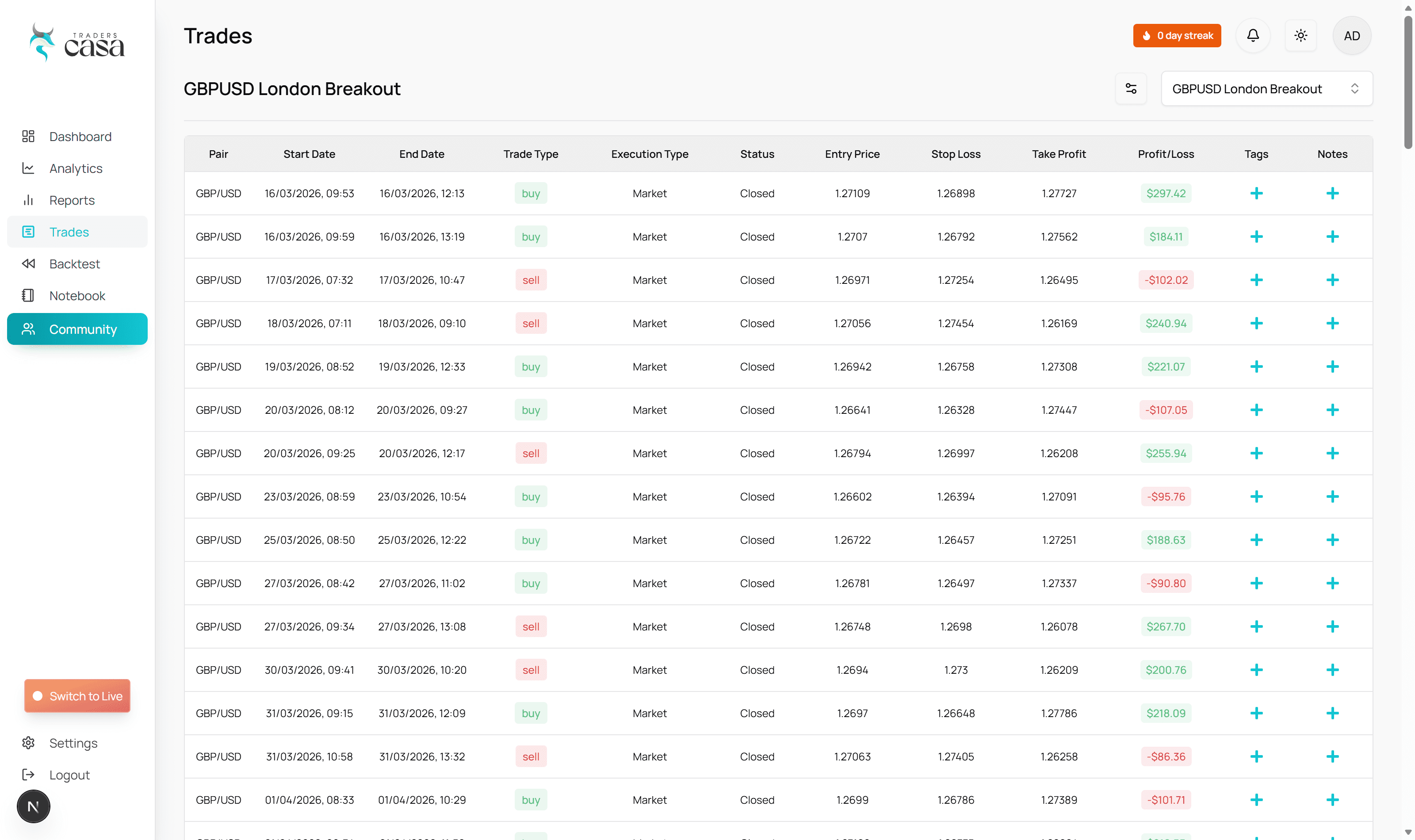
4. Log every trade
Record every valid trade, not just the interesting ones. At minimum, you need enough information to reconstruct what happened: entry, stop, target, result and any relevant setup conditions.
Consistency matters here. If you record ten variables for your winners but only "loss" for your losers, your journal isn't going to tell you much.
Traders Casa's free plan gives you unlimited backtest sessions, a P&L graph and consistency tracker using TradingView-powered charts and one-minute data. You get six months of historical data on Free, six years on Basic and 20+ years on Pro.
5. Review the metrics
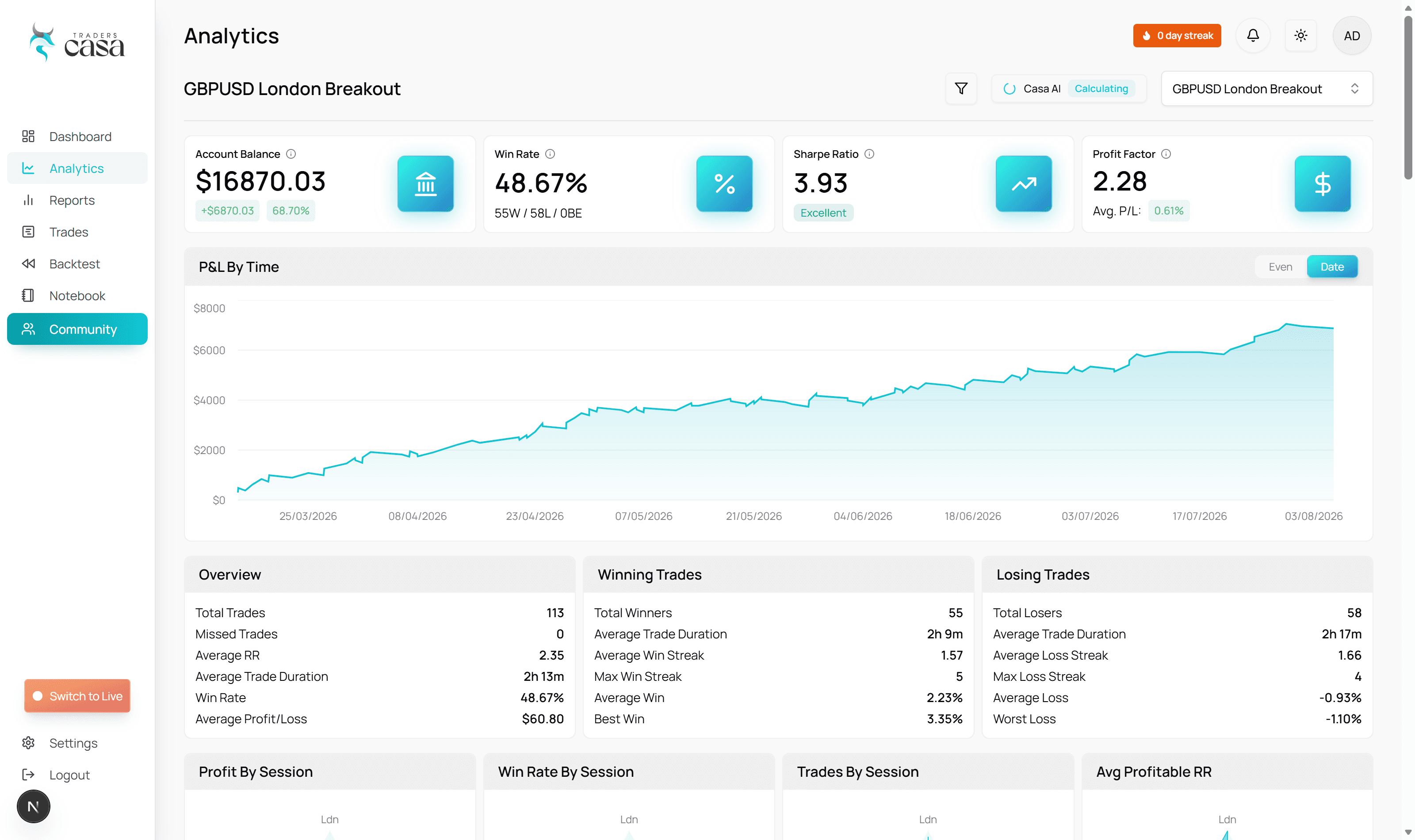
Once you've collected a meaningful set of trades, stop looking at individual winners and losers. Look at the strategy.
Calculate win rate, risk-to-reward, expectancy, drawdown and losing streaks. Then break the results down further where useful — by pair, session, setup variation or other variables you consistently recorded.
That's where the useful questions start. Not "Did this trade win?" But "Does this strategy have an edge?"
We also have a full step-by-step backtesting guide if you want to go deeper into the process.
Data quality: the silent killer
Your backtest can only be as useful as the historical data underneath it.
If your strategy operates intraday, testing from daily candles isn't enough. A daily candle can tell you the open, high, low and close, but it can't reliably tell you the sequence of price movements that happened inside that day.
That sequence matters. Imagine your stop and take profit both sit inside the same daily candle. Which got hit first? The daily candle can't tell you.
Lower-timeframe data gives you a much more detailed view of how price actually moved. Traders Casa uses one-minute data across all plans for this reason.
Sessions matter too. A setup triggered during the London open isn't necessarily equivalent to the same chart pattern appearing during a quieter period. If session timing is part of your strategy, it needs to remain part of your backtest.
Then there's execution. Historical charts look beautifully clean. Live trading isn't always so polite.
Spreads mean your effective entry and exit aren't necessarily the exact chart price. Slippage can create further differences between an ideal historical execution and what you'd actually receive.
You don't need to turn every backtest into a PhD thesis on market microstructure. You do need to avoid assuming every historical fill would have been perfect.
A tiny unrealistic advantage repeated over hundreds of trades can make a mediocre strategy look much better than it is.
The metrics that matter
A profitable final P&L is nice. It isn't enough. You need to understand how the strategy produced that result and what you'd potentially have to endure while trading it.
Win rate
Win rate is the percentage of tested trades that finished as winners. A 70% win rate sounds better than 45%, but that tells you almost nothing by itself. A strategy can win frequently and still lose money if its losses are much larger than its wins. Never judge a strategy from win rate alone.
Risk-to-reward
Risk-to-reward compares how much you're risking with how much you're targeting or making. If you routinely risk 1R to make 2R, you don't need to win every trade to potentially produce positive results. But use the results you actually achieved, not just the target you hoped price would reach. Your planned 1:3 setup isn't particularly impressive if you're constantly closing winners at 0.6R.
Expectancy
Expectancy brings your win rate and average wins/losses together. In simple terms, it tells you what the strategy can be expected to make or lose per trade across the tested sample. This is much more useful than asking whether the strategy "wins a lot". A strategy with a lower win rate can have better expectancy because its winners substantially outweigh its losers.
Max drawdown
Maximum drawdown shows the largest decline your backtested results experienced from a previous peak. This matters because two strategies can finish with the same overall return while taking completely different journeys to get there. One climbs relatively steadily. The other spends months digging a crater before eventually recovering. Same destination. Very different trading experience.
Losing streaks
Look at the largest number of consecutive losing trades in your test. If your strategy historically produced eight losses in a row, you need to know that before trade number six makes you decide the strategy is "broken". Losing streak data helps set expectations, and realistic expectations make it easier to distinguish normal strategy variance from an actual change in performance.
Common forex backtesting mistakes
Rewinding candles
You advance the chart. A perfect setup was hiding inside the candle you just revealed. So you rewind and take it. Don't.
You had information you wouldn't have possessed in real time. The trade is contaminated by hindsight and shouldn't be counted as a normal result. Missed it? Log it as missed if that's useful, then keep moving.
Curve fitting
Curve fitting happens when you keep modifying your strategy until it perfectly explains the historical data you've already seen. EUR/USD lost at 10:15? No trades after 10:00. Another loss appeared on Wednesday? No Wednesday trades.
Congratulations, you've just tested five different strategies without realising it.
Optimisation isn't automatically bad. But repeatedly changing rules to eliminate historical losers can create a strategy beautifully designed for the past and useless for the future.
Too few trades
Ten trades aren't enough to tell you much. Neither are 20 trades if your conclusion is, "This definitely works."
Small samples can be dominated by luck. A handful of winners can make a weak strategy look exceptional, while a short losing streak can make a viable strategy look terrible. You want enough repetitions to start seeing patterns rather than individual stories — here's how many trades you should backtest.
Mixing strategies mid-test
This one is easy to do. You begin testing Strategy A. Twenty trades later, you notice an additional confirmation that would have filtered several losers. So you add it.
Now the first 20 trades tested Strategy A and everything afterwards tests Strategy B. Those results don't belong in one clean sample.
Finish the original test first. Then define the modified rules and test the new version separately. Boring? Slightly. Useful? Very.
FAQ
How far back should I backtest forex?
Far enough to collect a meaningful sample and expose the strategy to different market conditions. A high-frequency intraday strategy may generate plenty of trades over a shorter period, while a setup that appears twice a month will require considerably more historical data.
Is backtesting forex free?
Yes. Free forex backtesting software exists, including Traders Casa's free-forever plan with unlimited backtest sessions, six months of historical one-minute data, a P&L graph and consistency tracker, with no card required.
Does backtesting actually work?
Backtesting works as a way to measure how clearly defined rules performed on historical data; it doesn't guarantee those results will repeat in live markets. Its value comes from giving you evidence about expectancy, drawdowns, losing streaks and strategy behaviour before you risk real money.
Quick Recap
- Forex backtesting means applying fixed trading rules to historical price data and recording every valid trade.
- Forex is particularly suited to testing because it trades 24/5 and produces large numbers of potential setups across different pairs and sessions.
- Manual bar replay suits discretionary traders; automated backtesting suits strategies that can be expressed as precise coded rules.
- Define your rules before looking through the historical period.
- Replay price forward without rewinding, and log every valid trade consistently.
- Data quality matters. Intraday strategies need enough detail to understand what happened inside larger candles.
- Don't ignore realistic execution factors such as sessions, spreads and slippage.
- Win rate alone tells you very little. Review risk-to-reward, expectancy, maximum drawdown and losing streaks as well.
- Don't change your rules halfway through a test. Finish the test, define the new version, then start again.
The objective isn't to prove your strategy works. It's to find out whether the evidence says it does.
Two things worth reading next. If you're weighing up tools, we compare 10 of them in best backtesting software. And if a prop firm evaluation is the reason you're testing, FTMO backtesting covers the drawdown rules that end challenges long before win rate does.
Backtest your forex strategy free, forever — bar by bar on TradingView-powered charts with one-minute data, unlimited sessions and a built-in P&L graph.
Start backtesting free